HYDIS

The Hypersonic Defence Interceptor System (HYDIS) programme is the wider European collaborative response to the pressing need for a new interception solution able to effectively protect European territory, population, high value assets and deployed forces in the years ahead.

The rise of new hypersonic missile threats poses a significant challenge for European and NATO ground and naval air defence systems. The Hypersonic Defence Interceptor System (HYDIS) programme is the wider European collaborative initiative developed to address the urgent requirement for a modern interception capability capable of safeguarding European territory, populations, critical assets, and deployed forces.

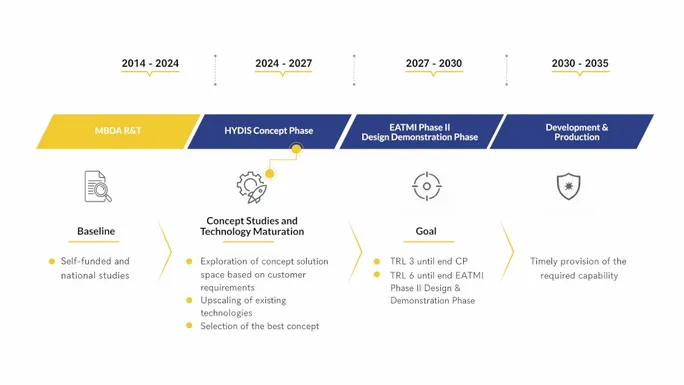
Managed by OCCAR and co-funded by four Participating States (France, Germany, Italy and The Netherlands), through a 3-year Concept Phase, the HYDIS programme aims to study, mature and select an effective interceptor concept or family of concepts to counter hypersonic threats, by achieving three main objectives:

  • to select the most suitable counter-hypersonic concept of interceptor (with potential variants) along with the associated weapon systems architecture; 
  • to mature the technologies necessary for implementing the selected counter-hypersonic concept in the next assessment and development programme phases; 
  • to establish the industrial network to develop the future counter-hypersonic missile systems.

HYDIS is contributing to the PESCO TWISTER (Timely Warning and Interception with Space-based Theater surveillance) initiative.

Hypersonic Defence Interceptor System (HYDIS)
Video file

0:00

Hypersonic Threats

Hypersonic Weapons have been developed to exploit gaps in defensive architectures.

Hypersonic Threats

Hypersonic Weapons have been developed to exploit gaps in defensive architectures.

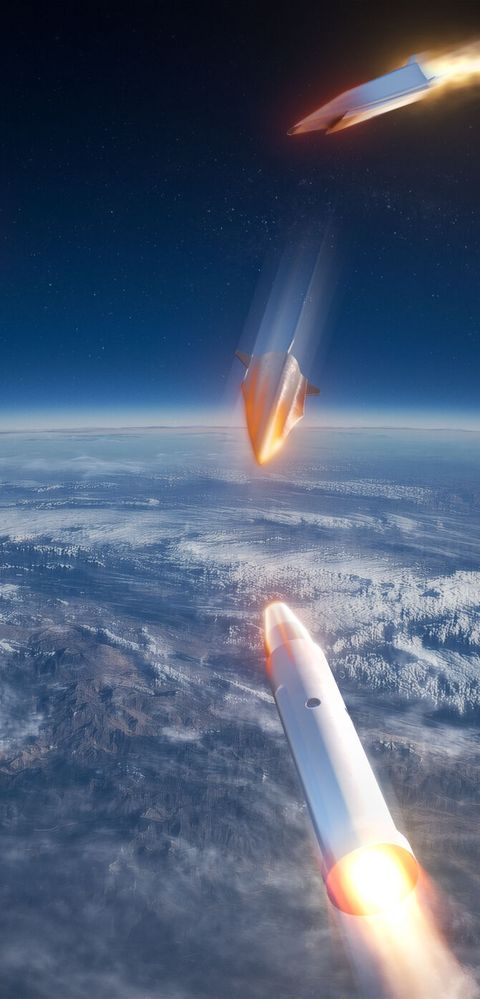
Due to their extreme speed combined with maneuverability within a specific altitude range, hypersonic threats (i.e. HGV, HCM, MARVs, ALBM) pose a significant challenge to their detection, tracking and, trajectory extrapolation. At present air defence systems cannot counter them as a whole set of threats. The interceptor system will also be able to defend against ballistic missiles, including IRBMs.

HGV: Hypersonic Glide Vehicle
HCM: Hypersonic Cruise Missile
MARV: Manoeuvrable Re-entry Vehicle
ALBM: Air Launched Ballistic Missile
IRBM: Intermediate-Range Ballistic Missile

Engagment Planning HYDIS

Engagement Planning

From a given initial position, the threat can perform a large variety of trajectories.The initially calculated PIP (Predicted Interception Point) needs to be constantly updated.

Engagment Planning HYDIS

Engagement Planning

From a given initial position, the threat can perform a large variety of trajectories. The initially calculated PIP (Predicted Interception Point) needs to be constantly updated.

The estimated position of the target is computed by the tracking filter, based on radar measurements and threat models. The generated information allow the guidance algorithms to evaluate and update the optimal interceptor flight path, in order to successfully intercept the threat.

Engagement chain

The engagement is done with cueing from external threat tracking (possibly including space-based sensors and ground based sensors) and hand over to organic sensors.

Engagement chain

The engagement is done with cueing from external threat tracking (possibly including space-based sensors and ground based sensors) and hand over to organic sensors.

Depending on the scenario, Launch on Remote and Engagement on Remote capability is also contemplated as well as a possible engagement solely relying on the systems own organic sensors.

Both cases consider the possibility of a C4I framework such as NATINAMDS, BMD and other future European one (EU-FIAMD).

System of Systems

The overall weapon system will be capable of engagement planning strategies with available assets. To adapt the high maneuverability of hypersonic threats, the engagement will be supported by smart trajectory optimization.

System of Systems

The overall weapon system will be capable of engagement planning strategies with available assets. To adapt the high maneuverability of hypersonic threats, the engagement will be supported by smart trajectory optimization.

HYDIS combines organic and non-organic sensors, to detect and track hypersonic threats. Distributed sensor suites including space based sensors and early warning capabilities allow a wide-area defence. 

The interceptor is designed to operate in various configurations: reduced sensor chains down to organic radars, to system of systems.

Technology

The interceptor consists of a multi-stage SRM for boost and cruise phase.

Technology

The interceptor consists of a multi-stage SRM for boost and cruise phase.
The architecture allows a high bird flight velocity, enabling late firing decision and implies modulated thrust mid-course stage and provides high mid-course manoeuvrability to counter threat cruise waving capabilities.

For the endgame the concept relies on an endo-atmospheric kill vehicle, with pyro controls for high manoeuvrability at hypersonic speed, guided by an IR-seeker with possible RF complement.

The interceptor is required to be operable in BMD defence architectures such as NATO BMD, future European one (EU-FIAMD) and national land and naval defence systems, hence ensuring the compatibility within the consortiums member states as well as other European countries.

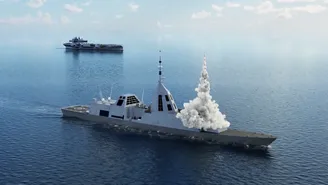
Specifically, in the naval domain, the interceptor will be integrated with Vertical Launching System such as Mk41s and the upcoming MMVL.

Advanced engagement planning relying on AI is under study for an optimal threats path prediction and to avoid unsustainable firing policies.

*MMVL and MK41S

  • Hypersonic Threats

  • Engagement Planning

  • Engagement chain

  • System of Systems

  • Technology

HYDIS is part of the PESCO TWISTER initiative.

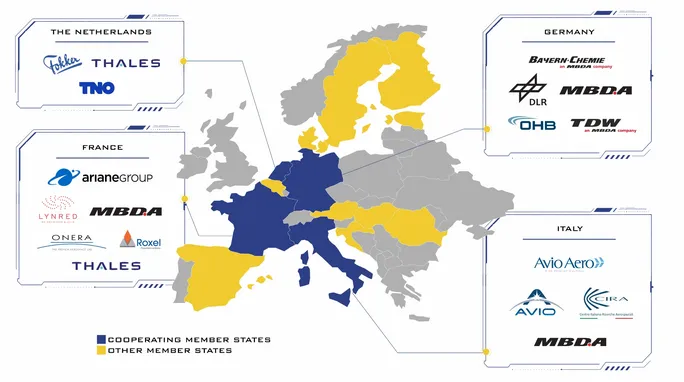
The project, managed by OCCAR, is supported by the European Commission (European Defence Fund) with additional funding from 4 nations : France, Italy, Germany and The Netherlands.

The Consortium is coordinated by MBDA France acting also as design authority.
ArianeGroup

ArianeGroup

ArianeGroup is the prime contractor of the Ariane 6 European launcher, in charge of design, production and commercialization of launchers, as well as the prime contractor of missiles system for the French oceanic deterrence force.

Main contributions to the project:

  • Divert & Attitude Control Systems.

https://www.ariane.group/


Avio

Avio

AVIO is a leading international group engaged in the development of space launchers and solid and liquid propulsion systems both for space travel and tactical applications.

AVIO is the prime contractor, launch service provider and launch operator for the Vega family of launchers, placing Italy among the limited number of countries capable of producing and operating a complete spacecraft, and key sub-contractor for the Ariane programme.

Main contributions to the project:

  • External booster 
  • Cruiser propulsion (rocket) 
  • High-temperature materials

https://www.avio.com/


Avio Aero

Avio Aero

Company operating in the design, manufacture and maintenance of civil and military aeronautics components and systems.

Main contributions to the project:

  • High temperature valve actuation for air-breathing motor
  • Plasma coating

https://www.avioaero.com/


Bayern-Chemie

Bayern-Chemie

Bayern-Chemie is the Centre of Competence for propulsion systems within MBDA with special skills and expertise in both controllable ramjet motors and solid rocket motors.

Main contributions to the project:

  • Controllable Ramjet Cruiser Motor
  • Solid Rocket Motor with TVC (End of Cruise)
  • Dual Pulse Solid Rocket Cruiser Motor
  • High Temperature Materials

https://bayern-chemie.com/en/


CIRA

CIRA

Italian Aerospace Research Centre promotes and operates research and technological development in the fields of space and aeronautics.

Main contributions to the project:

  • Characterization of two different threats
  • Plasma Wind Tunnel testing, in SCIROCCO facility, of a test article representative of the fin of the interceptor, in order to verify its capability to withstand the high heat loads experienced during the flight
  • Plasma Wind Tunnel testing, in SCIROCCO facility, of a test article representative of a generic threat, with the goal to measure the electron density in the vicinity of the wall, aimed at the validation of CFD codes

https://www.cira.it/en


DLR

DLR

The German Aerospace Center is the national aeronautics and space research centre of the Federal Republic of Germany with extensive research and development work in aeronautics, space, energy, transport and security.

Main contributions to the project:

  • Aerodynamic wind tunnel testing 
  • High temperature materials.

https://www.dlr.de/en


GKN Fokker

GKN Fokker

As part of GKN Aerospace, GKN Fokker is a leading multi-technology tier-1 supplier delivering advanced aerostructures, missiles and canisters, electrical wiring systems, and landing gear. The company is a key partner on high-profile defence programs. GKN Fokker’s facility in Hoogeveen, the Netherlands serves as a global centre of excellence for lightweight composites

Main contributions to the project:

  • MK41(S) launcher integration 
  • Missile canister design.

https://www.gknaerospace.com/


Lynred

Lynred

LYNRED, alongside its subsidiaries LYNRED USA, and New Imaging Technologies (NIT), is a global leader in designing and manufacturing high quality infrared technologies for aerospace, defense and commercial markets. It has a vast portfolio of infrared sensors that covers the entire electromagnetic spectrum from near to very far infrared, based on II-VI, III-V and micro-bolometers compound IR detector materials.

Main contributions to the project:

  • Electro-Optic sensor.

https://www.lynred.com/


MBDA

MBDA

MBDA is the only European group able of designing and producing missiles and missile systems that meet the whole range of current and future needs of the three armed forces (air, sea, land).

MBDA is the result of the merger of the main European missile systems companies capitalizing on more than 50 years of experience in Missile and Missile systems development and production.

MBDA has been leading many international development programmes in cooperation with other companies.

Main contributions to the project:


MBDA France

  • Programme Coordination, Engagement Planning and Trajectory optimization, Aerodynamics, Terminal Vehicle Physical Architecture, EO sensor

MBDA Germany

  • Ramjet, Aerodynamics, Aero-propulsion & airframe, Controllability and Mid-Course Guidance, Cruiser Physical design (ramjet concepts)

MBDA Italy

  • Platform Separation, Lethality, Controllability and Mid-Course Guidance, All-up interceptor physical architecture, RF seeker, Contribution to EO seeker subparts design, Datalink

MBDA Spain

  • Operational Battle-lab modelling and operations

https://www.mbda-systems.com/

OHB

OHB

OHB System AG is a provider of space based early warning and tracking capabilities, enabling interceptor and hypersonic defense systems with precise, persistent, and decision relevant information.

Main contributions to the project:

  • Space-based sensor capabilities.

https://www.ohb.de/en/


ONERA

ONERA

ONERA is the French national expert institution for aerospace and defense topics, in which it has top-tier contributions to research and industrial projects for decades. The fields of expertise embrace, among others, aerodynamics, energy, material, electromagnetic and optics for both theoretical and experimental studies.

Main contributions to the project:

  • EO sensor 
  • Threats characterization
  • High-temperature materials

https://www.onera.fr/en


Roxel

Roxel

Roxel has a strong experience and a recognized know-how in propulsion systems. Roxel designs, develops and manufactures a full range of solid propellant-based energetic materials on the majority of existing and future missile programmes.

Main contributions to the project:

  • Terminal Vehicle axial motor
  • Thrust Vector Control
  • Pyrotechnic Control System
  • Divert evolutions

https://www.roxelgroup.com/en/corporate/


TDW

TDW

Company experienced in the design and manufacture of warheads and warhead systems including the associated fuzes and safety and arming devices.

Main contributions to the project:

  • Lethality trials
  • Warhead design

https://www.tdw-warhead-systems.com/en/


THALES LAS France

THALES LAS France

Thales LAS is the Company of THALES Group specialized on designing and manufacturing of Land, Naval and Air Defence Systems

Main contributions to the project:

  • RF seeker (in cooperation with MBDA Italy).

https://www.thalesgroup.com/en


THALES Netherlands

THALES Netherlands

THALES Netherlands (TNL) is the leading supplier for multi-function radars and provides its expertise regarding naval and ground based radar sensors within the consortium. TNL is developing a new generation of radars with Early Warning Capabilities (EWC). These radars significantly increases the range and provide true defence capabilities against various threats such as ballistic missiles and fast flying cruise missiles with its high resolution.

Main contributions to the project:

  • Surface radar design
  • Weapon System integration

https://www.thalesgroup.com/en


TNO

TNO

TNO (Netherlands Organisation for Applied Scientific Research) is an independent, not-for-profit research and technology organisation established by law in 1932. Its mission is to create impactful innovations that contribute to the sustainable wellbeing, security, and prosperity of society. TNO’s Defence, Safety & Security (DSS) unit is the primary entity dedicated to strengthening national and international security through science and technology. TNO DSS works closely with the Dutch Ministry of Defence and with a wide network of international stakeholders, including defence organisations, industry, and knowledge institutes.

Main contributions to the project:

  • Threats characterization

https://www.tno.nl/en/


HYDIS

10 Jul 2026

HYDIS reaches another key milestone towards the definition of a European interceptor
The HYDIS Project has just achieved another significant milestone for the concept development of the future European counter-hypersonic and anti...

Discover the article

HYDIS