© MBDA 2026
Virtual and augmented reality: strategic tools for the development of complex defence systems
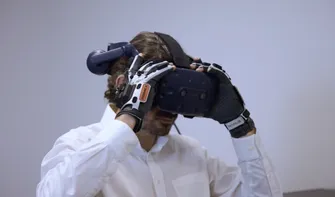
As defence systems become ever more complex, integrating advanced electronics, software, sensors and human-machine interfaces, Virtual Reality (VR) and Augmented Reality (AR) have become key strategic tools to accelerate innovation and development phases. These immersive technologies allow engineers and operators to visualise, understand, and interact with systems long before their prototypes physically exist.
For nearly a decade, MBDA has been developing VR and AR solutions to accelerate research and development, reduce technical issues, and improve overall system performance. By using full-scale 3D digital mock-ups in VR, MBDA teams can verify accessibility, ergonomics, and integration constraints at a very early stage and make design changes if necessary. AR complements this approach by enriching real environments with 3D digital information, creating a seamless bridge between the virtual and physical worlds. As Martial, Head of VR/AR development for MBDA in France, explains: “The aim is to provide teams with tools that accelerate system development by facilitating projection and detecting potential technical flaws as early as possible. With VR and AR, we aim for the best shot on the first try.”
© MBDA 2026
From design to maintenance: proven benefits across the entire lifecycle
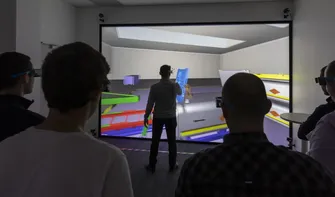
VR and AR are now used across the entire lifecycle of MBDA’s products, from innovation and design to integration and production, but also for training the teams who interact with the systems. Dedicated immersive rooms equipped with large Powerwalls and advanced tracking systems enable users to interact with 3D environments, manipulating systems at a 1:1 scale. Mobile VR suitcases also allow to be more flexible. Both operators and clients can train in the maintenance and use of the systems. This enables them to repeat processes in order to be fully operational once the system is delivered, therefore improving overall safety.
VR and AR are relevant for all product sizes, from individual components to complete systems. As Eric from Custom Support and Services at MBDA highlights: “This technology presents a real interest for all sizes of products, from a single part or sub-assembly to a complete missile system, and even down to the tooling that will be integrated into the systems tomorrow.” These technologies are already used within major defence programmes currently under development, demonstrating their maturity and operational relevance. The benefits are tangible: early risk reduction, better collaboration between disciplines, shorter development cycles, improved quality, and higher customer satisfaction.
© MBDA 2026
Scaling up immersive technologies for international co-development programmes
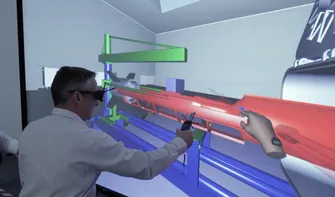
The wider use of VR and AR is paving the way for mixed reality, which combines real physical elements with full-scale digital objects within a single environment. This approach brings value during design, production, maintenance and system upgrades.
Beyond technology, VR and AR are powerful drivers of collaboration. By connecting immersive rooms across countries, international teams will be able to work together in real time on shared 3D projects. Cooperation initiatives, notably between MBDA in France, in Italy and in the UK, aim to harmonise tools, processes and methods of working. This pragmatic approach remains essential: “We do not use VR or AR just for the sake of it, but because the benefits are real,” stresses Eric and Martial. These technologies will foster development and co-development programmes, while reducing timeframes and improving the performance of defence solutions and capabilities.
Learn More about our Innovation Arena:
